Kollus DRM Content Service Flow
This document is a machine-translated draft and is currently undergoing review. Some content may be inaccurate or differ from the original Korean version. For the most precise information, refer to the Korean documentation.
This guide describes the entire process for distributing and playing back content with Kollus DRM applied. Refer to the service flow below when operating secure content.
For detailed information on content encryption (DRM), refer to the documents below.
Core process summary
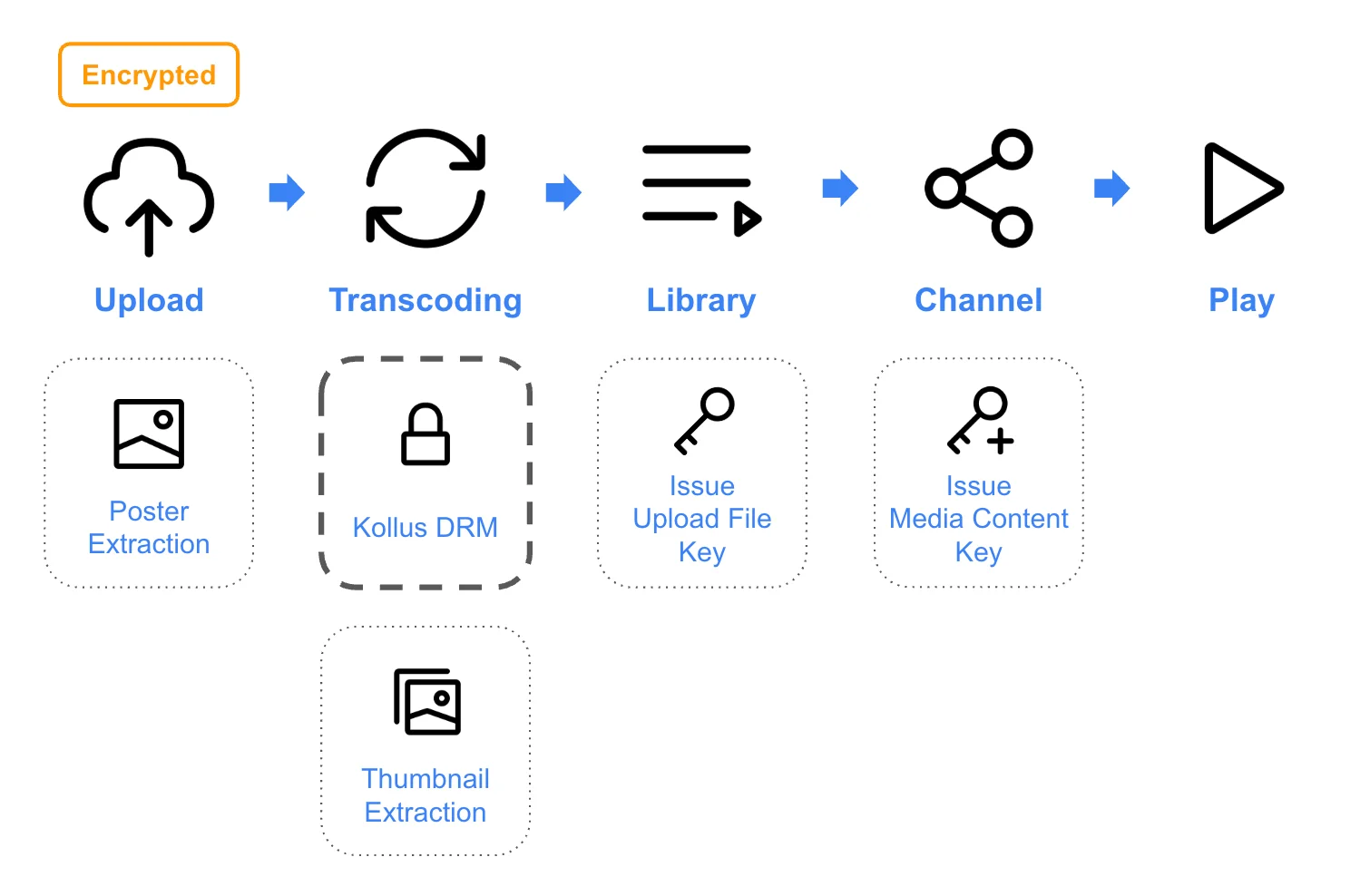
- Secure upload: The customer administrator sends the content file to the Kollus upload server. (Selecting the [Encryption] option is required.)
- Poster extraction: After the upload is complete, the system extracts a poster (representative image) to be displayed on the player's initial screen.
- Transcoding: An encoding process is performed to convert the content to the optimal resolution and bitrate for the playback environment. The customer administrator can check the progress status in [Library] on the Kollus VOD console.
- Content encryption (Kollus DRM): The media data is encrypted (packaged) using Kollus's proprietary security standard. This is an essential step for preventing unauthorized copying and leakage, and content that has been encrypted can only be securely played back through select Kollus Players.
- Thumbnail extraction: The system extracts thumbnail images to be used for preview in the player's progress bar.
- Upload file key issuance: Upon completion of transcoding and encryption, the system issues an upload file key for identifying the content.
- Channel registration and media content key issuance: When the customer administrator registers content to a specific channel, the system issues a media content key, which is the distribution identifier.
- Playback URL generation and verification: The customer administrator combines the media content key and security token to create a Playback URL (S-link). The final check for normal playback of the content is performed via the generated URL.
Tutorial
Step 1: Sign in to the Kollus VOD console
Go to the Kollus VOD console and sign in.
Step 2: Secure upload
In the [Library] menu that appears after signing in, you can manage content files and classify them by category.
- Click [Content upload] in the upper right corner of the screen.
- Select [Encryption] from the upload options. Encryption settings can only be configured at the time of upload and cannot be changed after the upload is complete.
- Drag and drop the file into the upload area or click [Select file] to select a file.
- Emoji restriction: Files cannot be uploaded if the file name contains emojis.
- Supported file extensions: Only the following extensions can be uploaded. Files with unsupported extensions may be excluded from the upload list or fail to upload.
- Video:
.3gp,.asf,.avi,.dv,.flv,.webm,.m4v,.mov,.mp4,.mpeg,.mpg,.wmv,.3g2,.3gpp,.f4v,.m2v,.ogm,.ogv,.wm - Audio:
.aac,.flac,.m4a,.mp3,.ogg,.wav,.amr,.wma
- Video:
- Maximum upload count: You can select up to 20 files at a time. To upload 21 or more files, use Kollus Uploader.
- When the upload is complete, the system automatically starts transcoding.
- Transcoding: An essential process that converts the original video to the optimal resolution and bitrate for various viewing environments.
- Progress status: Can be checked via the percentage (%) displayed above the content poster.
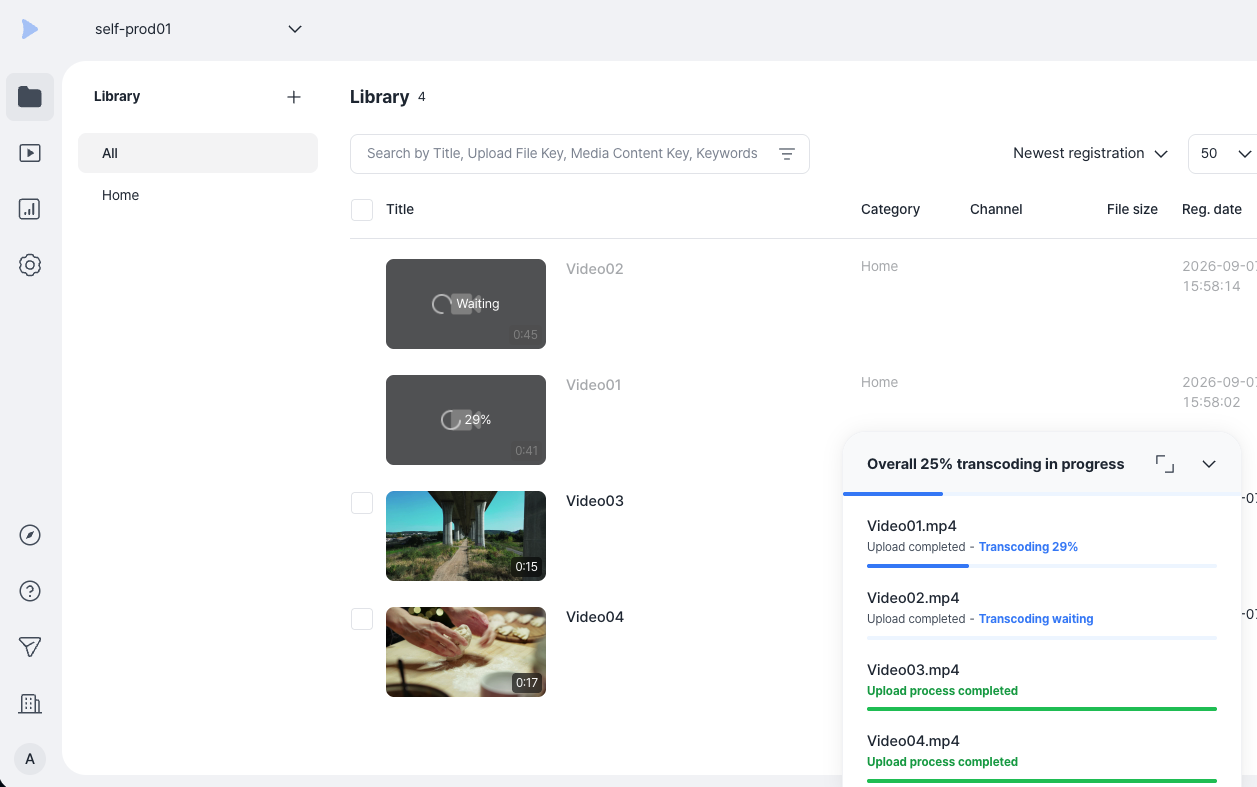
- When all tasks are complete, a shield icon is displayed in the lower right corner of the poster image.
Step 3: Create a channel
To deliver transcoded content, you must first create a channel. It serves as the fundamental unit for content distribution, allowing you to configure independent security and playback policies.
- Select [Channel] from the left menu.
- Click [Add channel] in the channel list or in the upper right corner.
- Configure each item and click [Save]. (Since this guide is for testing secure URL playback, select [Use as encrypted content-only channel].)
Item Description Channel name Channel identification name (emojis cannot be entered) Description Enter the purpose or management objective of the channel Channel settings - [Use as shared channel]: Provides URL and embed code for external distribution
- [Use as encrypted content-only channel]: Dedicated to content with Kollus DRM applied (Learn more: Content Encryption (DRM))
Delivery method Streaming and file delivery specifications (encrypted content-only channels support Progressive Download only) - [Progressive Download]: Sequential download method (for low-spec environments)
- [HLS]: Automatically optimizes video quality based on network conditions
- [HLS (AES-128)]: Enhanced security (adds AES-128 encryption layer)
Security settings - [Block playback when manipulating video watermark]: Immediately blocks playback when watermark tampering is detected
Step 4: Register content
Register content to the created channel.
- In the channel list, click [More (⋮)] to the right of the target channel > [Add content to channel].
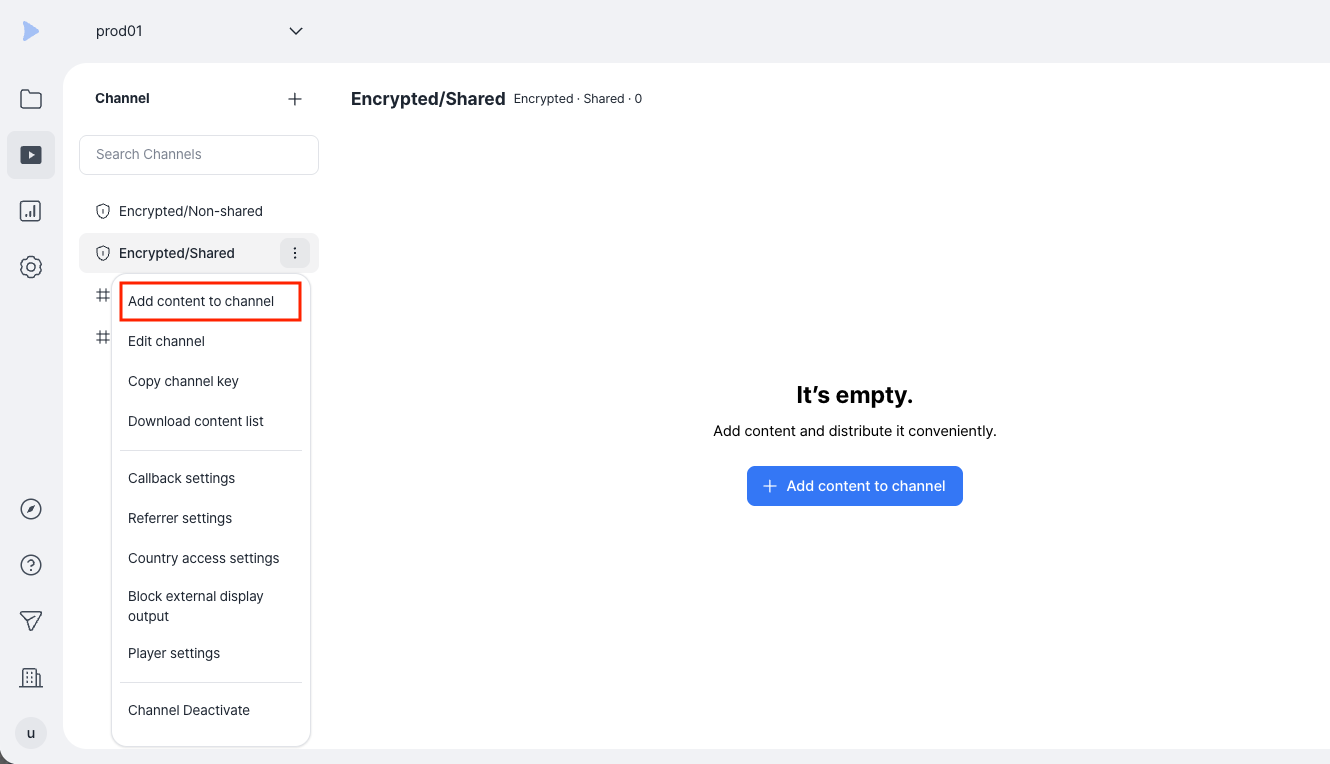
- Select the content to register and click [Add].
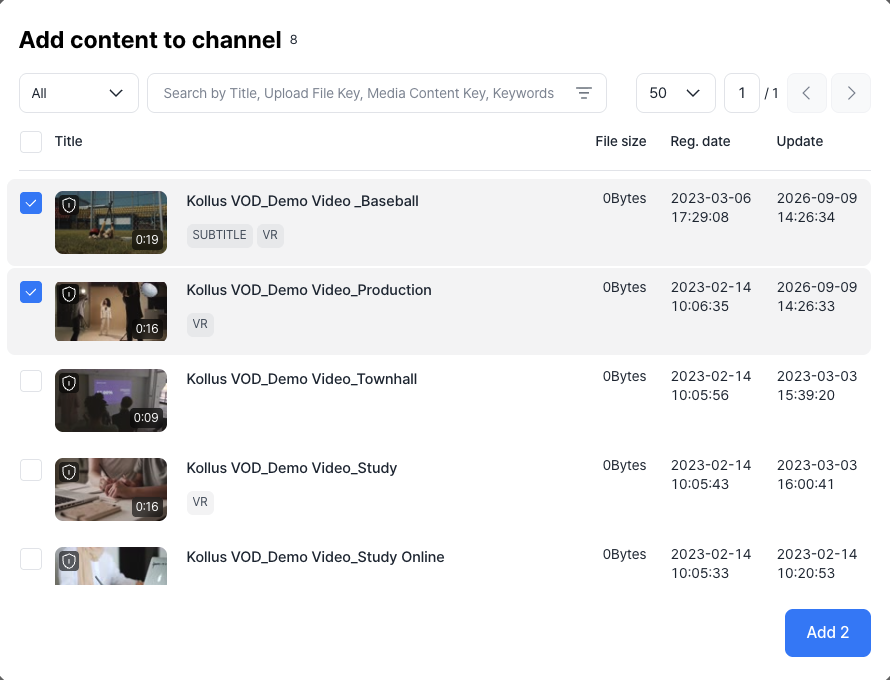
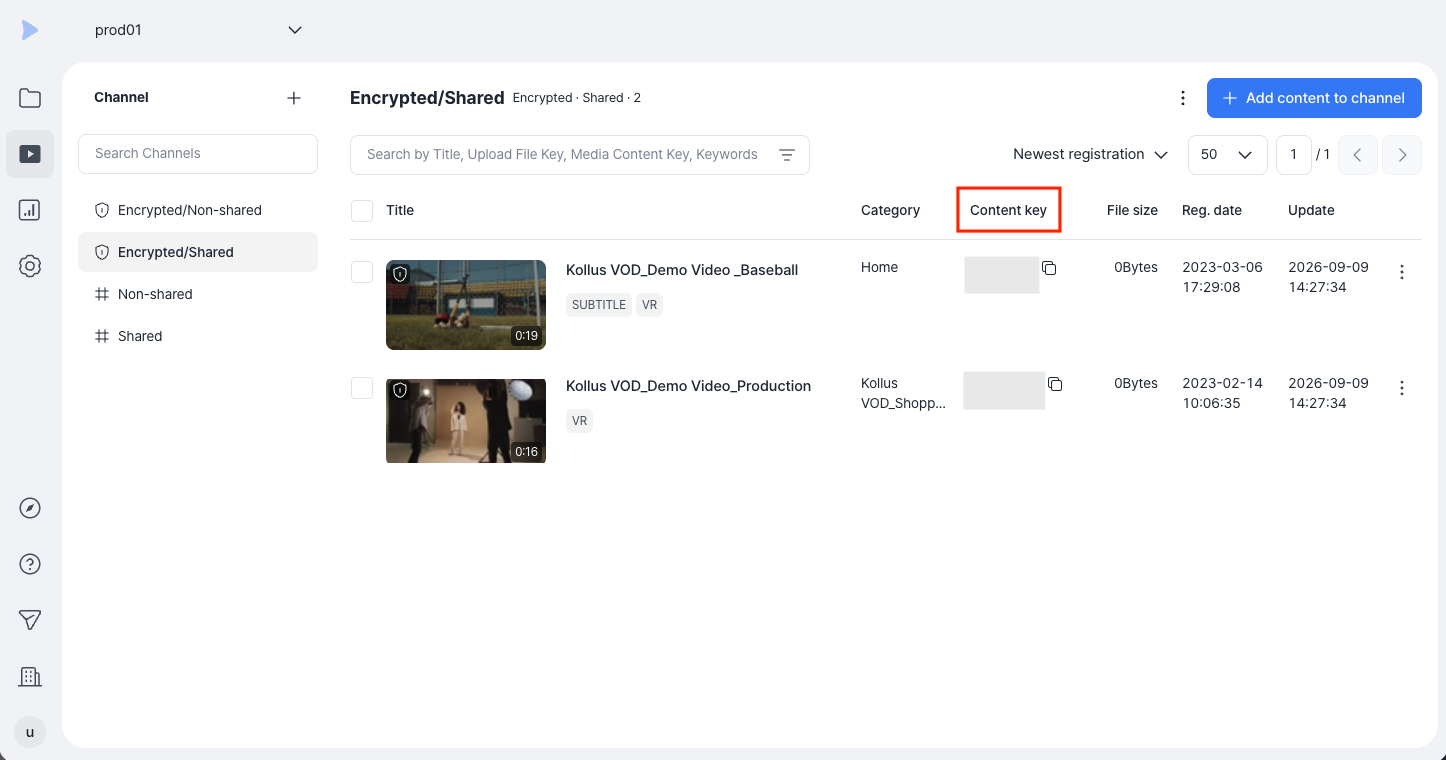
- Upon registration, a unique media content key is issued for each piece of content. This key is used as the distribution identifier per channel.
Step 5: Generate a JWT
Encrypted content uses JWT (JSON Web Token)-based authentication and playback authorization verification to maximize security.
Various security and convenience features such as watermarks, subtitle settings, and playback controls can be defined in the JWT Payload. The required Payload configuration for Kollus DRM content playback is as follows.
{
	"cuid": "{END_USER_ID}",
	"expt": 1703980800,
	"mc": [{
		"mckey": "{MEDIA_CONTENT_KEY}"
	}]
}
| Option | Type | Description |
|---|---|---|
cuid | string | User ID
|
expt | integer | JWT expiration date and time (Unix timestamp)
|
mc | array | Array containing information about the content to be played |
mckey | string | Media content key |
For identification information used to call the player, refer to the documents below.
- Key/ID information: Authentication and Keys
- JWT(JSON Web Token) specifications: Unified JWT Specifications
Step 6: Configure the secure playback URL
Configure the Playback URL using the secure URL (S-link) format so that only authenticated users can call the player. (Learn more: Player Call)
Playback URL format
https://v.kr.kollus.com/s?jwt={JWT}&custom_key={CUSTOM_KEY}
| Parameter | Description |
|---|---|
jwt | Authentication and security settings token (JWT generated in Step 5) |
custom_key | Custom key (Where to find: Kollus VOD console > [Settings] > [Custom key]) |
Step 7: Player playback and feature verification
Content with Kollus DRM (Digital Rights Management) applied can only be played in a secure player environment. (Learn more: Kollus Player Types)
Basic player features
The Kollus Player provides the following standard features for a smooth viewing experience. Check the full list of features on the Kollus Player Features page.
- Playback speed control: Supports 0.5–2x playback speed
- Navigation features: 10-second interval seeking and loop section
- Convenience features: PIP (Picture-in-Picture) mode support