Access Control (JWT)
This document is a machine-translated draft and is currently undergoing review. Some content may be inaccurate or differ from the original Korean version. For the most precise information, refer to the Korean documentation.
- PlanEnterprise
What is JWT-based content authentication?
JWT (JSON Web Token) is an industry-standard method for securely handling user authentication and authorization.
Kollus VOD implements the following high-level security measures through a JWT issuance mechanism based on a proprietary security key system.
- Prevention of URL tampering: After a playback URL is generated, signature verification ensures that the data cannot be arbitrarily altered externally.
- Fine-grained permission control: Playback permission is granted only to authenticated users, and content leakage is prevented by setting the token's validity period.
Keys used for authentication
| Authentication key | Description |
|---|---|
| Security key | A secret key used to ensure the integrity of the JWT. It is used when generating the signature. |
| Custom key | A unique identifier for the user. It is delivered together with the JWT and serves as the basis for determining which account's security key should be used to verify the signature. |
| Media content key | A unique identifier assigned to content registered in a channel. It is included in the token to prove actual access rights to the corresponding content. |
For key information, refer to the Authentication and Keys document.
Basic structure of JWT
A JWT consists of three parts.
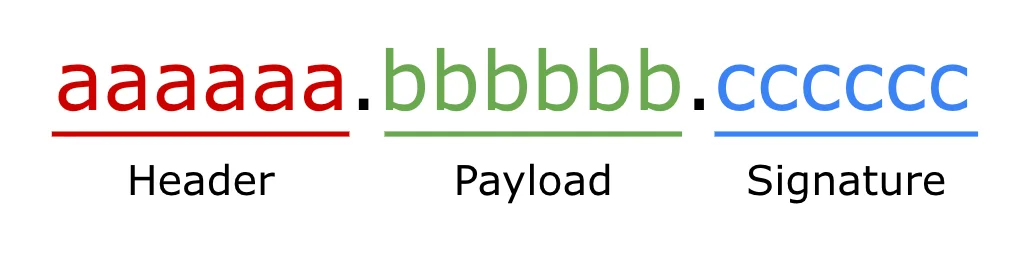
| Component | Role |
|---|---|
| Header | Contains the token type (JWT) and information about the encryption algorithm used for the signature (e.g., HS256). |
| Payload | Contains claims, which are the actual authentication information. This includes the user ID, expiration date, allowed media content keys, and more. |
| Signature | A value created by combining the header and payload, then encrypting it with a security key known only to the server. This is the key mechanism for detecting forgery or tampering of the token. |
Kollus VOD authentication processing workflow
Kollus VOD uses the industry-standard security algorithm HMAC SHA-256(HS256).
- Token request: When a user attempts to sign in to the service, the customer server checks the user's information.
- JWT generation: The customer server generates a JWT containing the user ID, expiration date, and other information using the security key.
- Playback URL request: The client combines the generated JWT with the custom key to request playback using a URL in the following format.
https://v.kr.kollus.com/s?jwt={JWT}&custom_key={CUSTOM_KEY}
- Integrity verification: The Kollus authentication server uses the received custom key to look up the corresponding account's security key and verify the JWT signature.
- Playback approval: If the signature is valid and the expiration date in the payload has not passed, a playback session is issued immediately.
JWT payload example
Below is an example JWT payload for user catenoid to play content vnCVPVyV(media content key).
{
  "cuid": "catenoid",
  "expt": 1703980800,
  "mc": [
    {
      "mckey": "vnCVPVyV"
    }
  ]
}
| Option | Description |
|---|---|
cuid | User ID |
expt | JWT expiration date (Unix timestamp) |
mc | Array containing information about the content to be played |
mckey | Media content key |
For detailed descriptions of JWT configuration, refer to the document below.